Saturday, January 16, 2016

Pioneer UC-V102 - Part 1

When I wrote about AUCNET I showed the path from my search from laserdiscs systems to the AUCNET NIA-2001. And that this was my best search, which gives AUCNET NIA-2001 and Pioneer UC-V102, and that I would talk about UC-V102 in a future post.

The future is now.


MSX2 Pioneer UC-V102
(another one compatible with Mitsubishi ML-G30 keyboard)

UC-V102 is a MSX2 computer by Pioneer. It doesn't have the MSX logo in the cabinet and the boot logo was disabled, but when you turn on this machine it goes directly to the BASIC prompt. No special firmware, just the good ol' MSX-BASIC 2.0.

MSX-BASIC prompt in Pioneer UC-V102
Pioneer is well known by the MSX community as the maker of two MSX1 models that have as special features the capacity to control some laserdisc players and superimpose their video output with the one generated by the computer. Pioneer even created a MSX BASIC extension called P-BASIC to control that special features.

Pioneer PX-7 + LD-7000 (picture from MSX Magazine 1984-07)

So, it's natural that Pioneer will be a great MSX2 supporter: the V9938 have greater graphic capabilities, more colors, more resolution, digitizer and genlock support, etc. In an exhibition in 1987, where some MSX manufacturers did show their new systems, Pioneer is there and showed the O-THE System:

News article from MSX Magazine 12-1987, featuring the "new" MSX2 from Pioneer

After that, no more news from Pioneer to the MSX world. There is no official MSX2 from Pioneer.

The Videodisc fever


Cover of BYTE Magazine
The videodiscs are a set of media and technologies that had the first commercial launches in the late 70s and comes to the present day with the DVD and Blueray disks. Some need a physical needle touching the disk, others uses the laser as a needle, some use digital formats, and others analog formats, some have a uniform data density, other have uniform spin velocity, etc.

But all they have a very important feature: you can watch an arbitrary scene, without the need to reel the tape to the correct position, which is a need in all the other video media of that time. With that, you can instantly goes from "scene 2" to "scene 10" and then goes back to "scene 3". This navigational capability and the high quality video makes the videodisc media the ideal for training courses, simulation machines, information kiosks, expositions and games.

CPR simulation system. There is an Apple II
behind the curtains controlling this system.
(Picture from BYTE Magazine 1982-06

Interzinc VIGS - Videodisc Gunnery Simulator
(Picture from Interzinc propaganda)

The early videodisc interactive systems are totally custom, with a computer interfaced directly to the player circuits. But the industry was quick and soon we had players controlled by RS232 and other easy interface options. Some players can load small programs from the media disc and be used stand alone, these are known as "Level 2" interactive systems. The interactive videodisc industry made a standard with "Levels", the laserdisc+computer set is the "Level 3", and is the level in use when you need more sofisticated control and additional capabilities.

Picture featuring the O-THE System in use for Computer Aided Instruction (CAI)
You can see the UC-V102 (video controller), the SS-D1 (video buffer) and the Laserdisc Player
(Picture from MSX Magazine 10-1989)

So, Pioneer did not sell UC-V102 as a MSX, but as a Videodisc Controller for "Level 3" interactive systems. I don't know if it was sold as an individual product, all documents that I found sells it bundled with other Laserdisc products as a integrated system: LD/VS1 in western countries and O-THE System in Japan. The target market was not the home computer, but the interactive videodisc systems market. This was a good move, the UC-V102 was one of the few MSX computers sold in North America.

It's interesting to see that the UC-V102 is the less "hidden" of Hidden MSXs. In the MSX Magazine 12-1987 article, it was identified as a MSX2. In the north american articles that I found about LD/VS-1 it's disclosed that the UC-V102 is a MSX2 computer, like this one:

"Compatibility of interactive videodisc systems"
Future Systems, 1987, Miller, Rockley L.

One of the authoring packages available for UC-V102 in western markets  is a version of CDS/Genesis system called "Genesis/MSX". And even MSX Magazine shows the computer again, in 1989, identifying the O-THE System as a "use of MSX" and compatible with the "MSX2 specification".

That's not a hidden machine!!! It's surprising that this system was unknown by MSX community for so long time, but besides the absence of MSX logo, there is no effort to hide that UC-V102 is a MSX computer. But what's inside this machine? That we will see in a next post.

Tuesday, January 12, 2016

Fujitsu-General TXR-21 and VXR-20

In this previous post I just wrote a little about Teletext and Videotex and their relationship. In this other one I wrote about the devices that looks like MSX but are not. This post is the offspring of those two previous posts.

We already talked a lot about CAPTAIN devices. And the only CAPTAIN device that the MSX community knew was, for real, a MSX. And I knew that many times the teletext and videotex share their presentation format. With that knowledge, when I saw the Fujitsu-General TXR-21, I wanted it.

Who's Fujitsu-General?


Fujitsu-General can not be know as a MSX manufacturer, but they have a history with MSX and, at least, two MSX computers released. But when those computers were released the company's name was "General".

General Paxon advertising

In 1985, General was bought by Fujitsu and the company name was changed to Fujitsu-General. The MSX manufacturers list on "MSX2 Datapack" already showed the new name.

Then, we already have two good signs to buy that machine: the only CAPTAIN adapter that we knew was a MSX compatible and Fujitsu-General has the know-how to build a MSX. And then I saw the TXR-21 expansion slot and the cartridges that goes there.

Fujitsu-General TXR-21 (top) and VXR-20 (bottom) frontal view

Back of TXR-21 and VXR-20, you can see the 50-pin slot
connector, (with a cartrige inserted), the printer port
(Centronics 14-pins female), the audio/video out (RCA),
the audio/video (RCA) in and the RGB21 connector.

Didn't this cartridge looks a lot like a MSX cartridge?

They are visually identical to MSX cartridges. Nothing could be wrong and I bought this item.

Well, all could be wrong.

What's inside Fujitsu-General TXR-21?


When I opened the TXR-21, there was only three components that remembered the MSX: the Z80 processor, the slot connector and the sound chip, YM2413.

TXR-21 mainboard: the Z80 is the small square chip at top right
and the YM2413 is behind the huge capacitor

Excluding the EPROMs and RAM, the main ICs are:

Intel P80C31BH: 8051 compatible 8-bit microcontroller
Fujitsu MB64H445: CMOS Gate Array
Fujitsu MB64H448: CMOS Gate Array
NEC 70008A4: Z80 processor
OKI M6254 (MSM6254RS): Don't know what is it
Toshiba TC9017N: Teletext, Screen Display Controller
Yamaha YM2413: FM sound generator, the same of MSX-Music

And that's all. Tabajara picked the two socketed ROMs and dumped their contents using a EPROM reader. Nothing interesting there (at least for MSX research). The strings inside the ROM still says TXR-20:

#T#X#R!]#2#0!!#T#E#L#E#T#E#X#T!!#R#E#C#E#I#V#E#R
#F#U#J#I#T#S#U!!#G#E#N#E#R#A#L!!#L#t#d!%

If you want to investigate those ROMs, they are in this tarball.

From what I could understand, the 80C31 waits in standby (it have a low consumption mode) and when it receives an event (from remote sensor by example), it activates the other board components. The Z80 is the main processor, TC9017 controls the video, YM2413 plays the CAPTAIN tones and M6254 "reads" the teletext data from the broadcast transmission.

That is a "Not MSX". Even the cartridges, while mecanically compatible with the MSX standard, are eletric and hardware uncompatible. The two kinds of cartridges that I have here for the TXR-20/21: one is a big memory buffer to holds many teletext data and the other one is the modem adapter.

The memory buffer

CAPTAIN adapter cartridge

What's inside Fujitsu-General VXR-20


Nothing

The cabinet is mostly empty, there is a small modem board at the corner. The cabinet size is to make a good looking set with TXR-20 or TXR-21 (they are almost identical)
 
The modem board, with many dip-switches

The big ICs on this board are:

NEC D7811G - 8-bit, single-chip microcomputer with A/D converter (the datasheet says the bus is 8085 compatible. Is the processor code compatible, too?)
NEC D7720AC - Programmable DSP

Funny story, I bought a CAPTAIN adapter cartridge "for MSX" some time ago and it doesn't works. I guessed it was because some circuit logic could be in the other end of cable (I got only the cartridge) or because it was defective. Now I know why: it's the same cartridge that cames with VXR-20, only the label is different.

My two VXR-20 cartridges
Probably the seller didn't knew what this cartridge was, but it looked like a MSX cartridge, had CAPTAIN wrote at label... and announced as a CAPTAIN adapter for MSX. Nice to see that I am not the only one fooled by those cartridges. I hope this post could help others to not made the same mistake.

Sunday, January 10, 2016

Videotex and Teletext

Laserdiscs controlled by computers were one of the new technologies in the magazines from the 80's. Another one that people were talking a lot was Videotex. End of 70's and beginning of 80's the Videotex were the connected future, together with the Laserdisc, they were knewn as "New Media".

The Networks before Internet


People would read magazines, check their bank accounts, buy show tickets, talk with each other and many other activities, using the network!! If you think that Videotex looks like the Internet, you made a good guess. It looks like Internet but Videotex networks are closed networks. Each network were isolated from the others, only those approved by the network owner can publish contents and only network customers can consume this content. And the Videotex systems from each telecom were different from the others, so a NAPLPS terminal couldn't show pages made for CAPTAIN.

Even with those characteristics that now we see like big problems, many videotex networks were still working until after the 2000's, the biggest one, called Minitel, was shutdown in France only in 2012.

The system created to the Japan by NTT was called CAPTAIN ("Character and Pattern Access Information Network") it was a bit different than the other Videotex systems because it needs to handle the characters of Japanese language, so instead of using graphic primitives (like NAPLPS) or semi-graphical characters (like Prestel), the CAPTAIN system sends the page image pre-rendered to the decoders.

NTT advertising showing many pages as a example of what you can do with CAPTAIN

As a new computer standard, the MSX couldn't be out of Videotex revolution. Sanyo made a CAPTAIN adapter for MSX1 (which include a special graphics adapter because CAPTAIN minimum resolution is 248x204, 12 lines more than what MSX1's VDP can do), Yamaha did a CAPTAIN adapter for MSX2 (an easier job as the MSX2's VDP can reach a not-interlaced resolution of  512x212) and NTT did the NTT CAPTAIN Multi-Station.

The green box talks about Yamaha CAPTAIN adapter

I guess that other countries with MSX computers and Videotex systems had some adapter to connect MSX to Videotex. In Brazil, you could buy a modem cartridge (from any of the many manufacturers) and connect your MSX to "Videotexto", the Telesp (one of Brazilian telecoms) bought many Gradiente Expert with modem cartridges and lease them to their customers to serve as Videotex terminals.

Some cartridges to connect the MSX to "Videotexto": a modem from Gradiente and two RS-232C interfaces from Sharp and Cybertron
(pictures from retroplayerbrazil and from a MercadoLivre auction)


So, to use a Videotex network, you needed to be a subscriber, to have a phone line and a compatible terminal. That compatible terminal could be a dedicated one (like NTT CAPTAIN Multi-Station) or a generic home computer with a modem, the software and the graphical capabilities to show your Videotex system screens (like a home computer + Videotex adapter).

Teletext, the Videotex system of Television Broadcasters


To be fair, the Teletext is older than Videotex. It was created by BBC and used the interval between TV frames to send data. But it's an one way communication: the TV repeatedly sends the data frames in a carrousel: first the weather frame, then the national news, then the calendar, then public advisories, and when it reaches the end, goes to beginning with the weather.

You use your remote to select (through a menu) what you want to see, and when that screen was broadcasted your Teletext decoder shows it on screen. So it looks like you are requesting the information that you want to see. That illusion was even better if your decoder have a lot of RAM, so it can cache many screens and you can see then just after selected at menu. These traditional teletext services are being shutdown as analog transmissions are coming to an end.

Well, back to the history, British Telecom was creating their Videotex system, and did want to send data through phone lines and show the received information on TV screen, more or less the same that BBC was doing. As videotex and teletext wanted to share the output media (the TV set), in 1976, both agreed in a shared output format, so the manufacturers could share components and designs to both systems and, hopefully, bring the prices down.

Learning from british experience, other videotex formats are shared with their teletext equivalents. That's the japanese case, which CAPTAIN format is shared between the Videotex service and the teletext broadcast.

So, that machine makes a lot sense:

Zoom of TELETEXT/CAPTAIN device

Saturday, January 9, 2016

We can't always have success

As I wrote in previous articles, one of the signs that helps to recognize hidden MSX devices are visual: MSX peripherals (joysticks, trackballs, keyboards, tablets, etc) or connectors that we relates to MSX (50-pin slots, keyboard, cassette, etc).

Those physical evidences plus those that we got by documental research, makes we try and buy a different device, with the hope that we will discover another piece of MSX history.

Most times that doesn't works. That's why I created the "Not MSX" category in this blog. So I can show these failed attempts and prevents other people to lose their money with the same mistakes.

Of course I will not write here about all "Not MSX" that are in the world, but about stuff that looks to be a hidden MSX, some even uses MSX custom ICs, and are not.

Wednesday, January 6, 2016

AUCNET NIA-2001 - Part 4

The last post ended with one cliffhanger: Japan Business Television had the know-how and a good relationship with ASCII to build a hidden MSX TurboR machine? We never will know for sure, what we can know now is that even if JBTV had these items, they don't use them to build NIA-2001. There is another name in NIA-2001's circuit boards and firmware: Takaoka.

This machine was build by Takaoka Electric, and we don't even know if JBTV have any exclusivity on this hardware.

They had the know-how and good relationship.


Takaoka had experience with computer terminals from 1982, with a Kanji Terminal, produced X-Terminals for UNIX and still have a thin client division, Mintwave. In 1987 they created a CAPTAIN terminal to Kobe Port, and that terminal will be familiar to MSX fans:

NTT CAPTAIN Multi-Station (picture from MSX Magazine 1988/01)

NTT CAPTAIN Multi-Station is a MSX2 and a CAPTAIN terminal and was created by three companies: NTT, Takaoka and ASCII. So, Takaoka had experience with MSX and a good relationship with ASCII. Knowing the NIA-2001 internals, I guess that the hardware of NTT CMS was all done by Takaoka.

Official MSX TurboR were released in 1990. While we know that only one manufacturer release TurboR machines, we also know that ASCII wants to sell their chips (e.g.: R800 and S1990) and wants to license their designs to as many manufacturers as possible. The TurboR reference design probably was licensed to Takaoka, but not the MSX brand. With that, Takaoka got a versatile terminal platform (can be use as text terminal, CAPTAIN adapter, multimedia controller, etc) and ASCII sells their chips.

Hard to know if Takaoka already had the TurboR design and only adapt it to their customers, or if they got this design specifically to create a terminal for JBTV; the evidence suggests that NIA-2001 is a multi-use system.

The external slots, superimposer and modem circuits are on daughter boards, and the mainboard have unpopulated sockets, empty IC places and unused connectors. There is even one connector that can be a internal slot.

The main board, in its bottom right you can see a unused 50 pins connector.

The modem board

The audio/video board with superimposer
To sell it as a Laserdisc controller or as a subtitler, remove the modem board and provide some storage. To sell as a CAPTAIN terminal, change the superimposer board for one with only the output video connectors and keep the modem board. To be a good old 80x25 text terminal, you don't need modem or superimposer, only RGB output and serial port.

While it's shown as the AUCNET's terminal from 1989, we can't know for sure that the terminal in the picture is the one used in 1989, the guy that makes the movie could have selected the first terminal after the satellite system introduction, and we can't know what board is inside the machine in the picture. The JATE certification codes from 1992 points to a late release, and both S1990 and R800 are from 1990.

Even with these signs of a later release, the NIA-2001 could still be released in early 1990. The main board on my NIA-2001 is revision C and the only commands added by MSX-BASIC 4.0 are _PAUSE, _PCMREC and _PCMPLAY, but the NIA-2001 didn't have the additional hardware needed to support for PCM; the first mainboard revisions could come with MSX-BASIC 3.0 or even a version of MSX-BASIC 4.0 still in development. Which is good for a embedded device not always is good enough for a home computer.

The MSX TurboR timeline probably is: NIA-2001, based in ASCII reference design, is released in early 1990 by Takaoka; in parallel Panasonic develops their own TurboR machine, the FS-A1ST. Takaoka updates NIA-2001 with MSX-BASIC 4.0 and with the BIOS with deffective PCM sometime in 1990, at same time, Panasonic fixes the BIOS (or get a fixed one from ASCII) and releases FS-A1ST with a functional PCM implementation... almost in 1991!!!
MSX Magazine from October of 1990, presenting the MSX turboR

The ROM revision in my NIA-2001 have the same MSX-BASIC 4.0 of TurboR A1ST, but the BIOS looks to be an earlier version. While the additional commands are all there, _PCMPLAY gives no sound and the support for _PCMREC is bugged, the machine reboots if this command was called.

Since the MSX-BASIC commands were not usually used in embedded systems, like the NIA-2001, looks like this ROM version was updated until the one that "works" and was not updated in subsequent releases. The firmware was still updated as we can see in the boot screen, at least until 1992, the same year of JATE certification codes. The machine in my hands was built in 1993-12, we can guess that the JATE codes are related with the certification of the mainboard revision C, in 1992, the same date of the updated firmware.

After that, Takaoka continues to do small updates in its terminal, and Panasonic releases FS-A1GT. The relationship of Takaoka and AUCNET with the MSX opens many questions: Did AUCNET terminals from 1985 and 1996 are MSXs, too?  Takaoka made more MSX Turbo R and sold to other customers? Did ASCII licensed the TurboR reference design to other manufacturers?

Monday, January 4, 2016

AUCNET NIA-2001 - Part 3

In the first part of this article I showed the AUCNET NIA-2001, in the second, who's AUCNET and what was the purpose of NIA-2001 in AUCNET's business. Now is time to show who really built this machine and where NIA-2001 is located in MSX TurboR's timeline.

AUCNET is the new MSX TurboR manufacturer?


This would be an easy question to answer: there is a big "AUCNET" printed in NIA-2001's front, so AUCNET would be the manufacturer. But, when you turn the machine on, there is no AUCNET in the custom opening screen, you can't find "AUCNET" character string in the machine's ROM, even the PCBs doesn't have AUCNET printed anywhere.

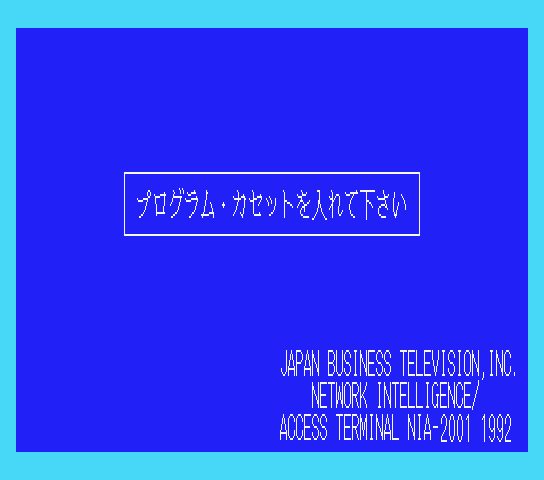
When you turn on the NIA-2001 , it shows this screen:

Boot screen of NIA-2001 (picture taken using BlueMSX emulator)

The company name in boot screen is "Japan Business Television, Inc" and the japanese text on the center translates to: "Insert program cassette". Remember, the NIA-2001 comes with a cartridge, the AUCNET software is provided in this separated cartridge.

This screen also helps us to have the firmware date, 1992. At the back of NIA-2001 there is a seal:

Close view of the seal on NIA-2001's rear

The japanese text on this seal reads:

Approved equipment name NIA-2001
Approval number
S92-3136-0
M92-N194-0
Power consumption AC100V 40W
Manufacture
Year 1993 Month 12
Japan Business Television, Inc

From this seal you can see: the date when this NIA-2001 unit was made (1993-12); the JATE (japanese "FCC") certification codes (S92-3136-0 and M92-N194-0) and, again, the "Japan Business Television, Inc" name. That was the company that ordered this machine and the one that did pay the JATE's certification fees.

When the AUCNET began their operations with sattelite broadcasting they created a new company to take care of these operations. In 1988 the "Japan Business Television, Inc" was created, being the first multimedia analog time-division multiplex transmission system in Japan (1989). With this business division, makes sense to have JBTV responsible for the satellite receivers and terminals. Maybe these NIA-2001 terminals had other uses in JBTV, they could be good subtitlers and special effect generators, but that's pure speculation.

Now we know that JBTV has good skills in satellite technology (and today they provide many other IT and communications services). But they had the know-how and a good relationship with ASCII to build a hidden MSX TurboR machine?

Saturday, January 2, 2016

AUCNET NIA-2001 - Part 2

In the the first part of this article I show the AUCNET NIA-2001 machine and it's specifications. But who's AUCNET and why it needs a MSX?

A bit of archeology


When I started to search about hidden MSX machines, I read a lot of old magazines. Some magazines were MSX related and some related to general computing. The idea was to find the technological trends at the eighties and if some of those trends could be fulfilled using MSX computers.

One "big" thing at those old magazines was the marvellous things that can be done using Laserdiscs. They talk about the amazing graphics, the sound, the capabilities and futures possibilities of the integration between the computers and Laserdisc players.

And I knew that Pioneer did two MSX models that can control Laserdisc players. There is even some MSX games released in Laserdisc format. If you did want to play those games and didn't have one of those Pioneer MSX models, you can buy a separated interface that can be used in any MSX1 computer:

Pioneer PX-7 + LD-7000 (picture from MSX Magazine 1984-07)

So, this was my first target: to find uses for computer controlled Laserdiscs and check if these computers are MSX or MSX based. That approach gave to me two unknown MSX models: Pioneer UC-V102 (I will show this MSX2 in detail in a future post) and, indirectly, the AUCNET NIA-2001.

The first online auction system


AUCNET sells used cars, online, since 1985. The AUCNET's founder was a visionary and wanted to use the new technologies to start a new kind of auction system: people would see pictures of the cars and bid for them using a computer. This way, people could buy used cars from anywhere in Japan, without the need to physically go to where the cars are located.

To make this idea work, people needs to see very good pictures of the cars being auctioned. That's where the Laserdisc enters in the system, the AUCNET representatives goes to the cars and take notes about its conditions and those very good pictures, then the pictures are recorded in a Laserdisc and these Laserdiscs sent to the auction's point-of-sales spread through Japan.

Another important thing in an online auction system is to have all machines synchronized, so the winner bid will always be the only winner. You don't want to be "the winner" and just a few seconds later the auctions system tells that another guy won. To solve that, all the AUCNET's terminals were equiped with modems that talks using PSTN to regional hubs and those send the bids through dedicated lines to the central computer.

Now they only needed a computer to be used as AUCNET terminal, one that could superimpose the Laserdiscs movies with computer generated graphics, could control the Laserdiscs so the correct picture will be shown at the right time and could communicate using a modem. These specifications makes AUCNET terminals good candidates to be hidden MSXs. So they entered in my search list.

Sometime between 1985 and 1989, AUCNET swaps Laserdiscs for satellite broadcast, it's easier and cheaper to reach all the country with high-resolution pictures broadcasting them from space, than recording and sending hundreds of Laserdiscs to hundreds point-of-sales every week. Even with these change in picture's media, the AUCNET terminals were still good candidates to be hidden MSXs, being equiped with superimposer hardware , they only need to change the image source from a Laserdisc player to a satellite receiver.

You can see more about AUCNET in here:


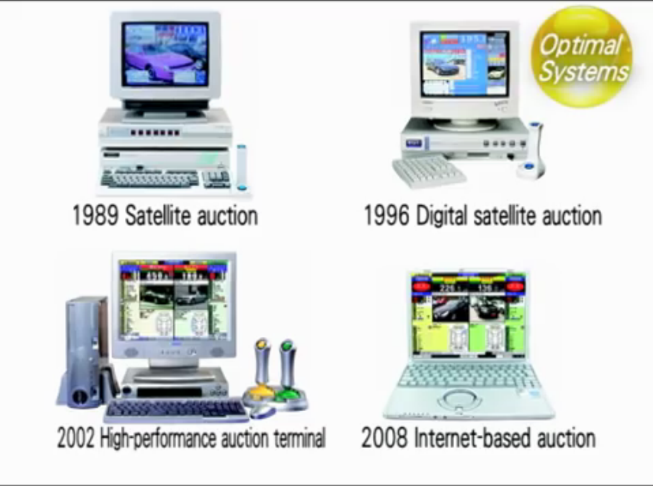
In this video you can see images of AUCNET terminals from 1985 through 2002, NIA-2001 is the one from 1989. I didn't know at that time, but you can see it using the same keyboard of Mitsubishi ML-G30.

AUCNET Terminals from 1989 to 2002, extracted from AUCNET's propaganda.

Another picture of a complete system is this one, again, you can recognise the keyboard:

1989 AUCNET Terminal - picture extracted from "Electronics Intermediaries: Trust Building and Market Differentiation", 1999, by Lee, Ho Geun and Clark, Theodore H.

AUCNET does not sell these terminals, the machines were leased to their dealers and must be returned to be upgraded or if the dealer leaves AUCNET's network. This situation makes those terminals very hard to find. After some time searching, I found one AUCNET terminal for sale, that was the AUCNET NIA-2001 that I have. I did some new researchs and I found images of the 1985 terminal with an well known joystick.

1985 AUCNET Terminal, extracted from AUCNET's propaganda.

The auction's pictures shows one joystick connector at front of NIA and I did suspect that the slot at back was MSX compatible. So, I taken my chances and bought this terminal.

Only some months later, when the machine arrived from Japan,  I could see that it was, indeed, an MSX and, even better, a new MSX TurboR machine. This discovery starts a lot of new research and speculation...